
Professional Services
CRM, invoicing, time tracking, and project work for service teams.
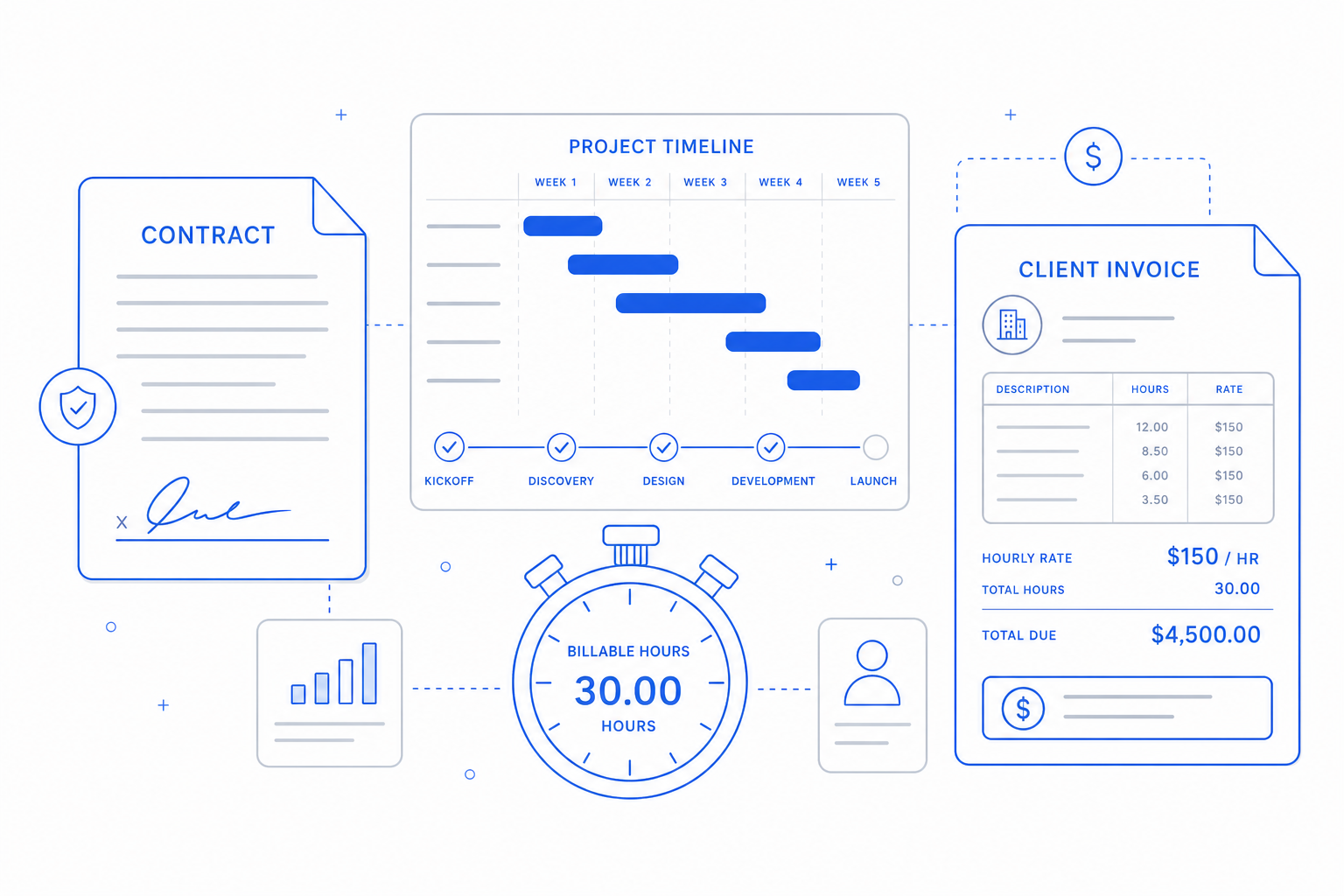
Professional services firms run on time, projects, and trust. CloudIP turns each of those into a first-class object: time entries roll into invoices, projects roll into reports, and customer communications roll into the customer record.
No more time-tracker plus PSA plus QuickBooks fragmentation.
How Professional Services use CloudIP
Time-to-invoice
Time entries on tasks become billable lines on invoices automatically.
Project reporting
Per-project margin and utilization reports.
Communications on the customer
Calls, emails, and meetings attached to the customer record.
Subcontractor management
1099 contractors paid and tracked from the same module.
Running Professional Services on CloudIP
The tradeoffs that matter once industry-specific tools meet a real general ledger and a real customer database.
Professional Services businesses share an operational shape that generic SaaS keeps trying to ignore. Customers assume that the tool meant for CloudIP for professional services understands the difference between, say, time-to-invoice and subcontractor management. CloudIP is built around those distinctions rather than around them.
That matters because the cost of misfit software in Professional Services is not abstract — it shows up as missing audit evidence, lost revenue, and weekend reconciliation work. By keeping the operational record, the financial record, and the customer record in one platform, Professional Services customers replace the brittle integration layer with a single source of truth.
The trade-off CloudIP optimises for is operator time. Every workflow that runs on the platform is one workflow with documentation, support, and an upgrade path — not a chain of vendor relationships you have to chase when something breaks. Professional Services teams using CloudIP report shorter monthly closes, lower vendor counts, and faster onboarding for new staff.
Professional Services questions, answered
Yes — CloudIP for professional services is one of the named use cases CloudIP is designed around. The capabilities mentioned above are part of the standard subscription rather than an industry add-on, and the team has run implementations across the patterns listed in the scenarios section.
Modules to start with
Leads, deals, and forecasts in a CRM that talks to invoicing, marketing, and the phone system.
Double-entry bookkeeping, banking, and reports — built like QuickBooks, priced like a feature.
Tasks, todos, meetings, and shared spaces — replace the side stack of project tools.
Phones, voicemail, video, webinars, SMS, and AI agents — one platform for every conversation.
Try CloudIP for Professional Services
14-day trial with every module enabled. We'll help you import data from your current tools.