
Run your whole businesson one platform.
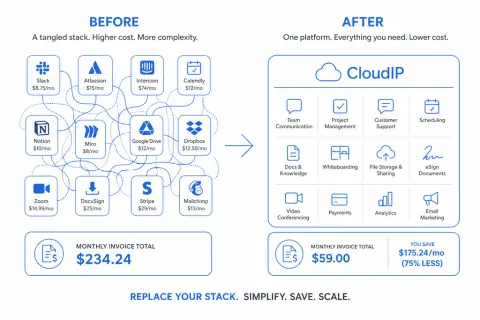
CloudIP replaces the dozen separate vendors most SMBs juggle — accounting, CRM, HR, payroll, communications, e-commerce, POS, backup, and the hardware to run them — with one subscription, one user database, and one bill.
- 12 modules, one user database, one bill
- Replace ~15 SaaS subscriptions per business
- Typical 60–75% reduction in software spend
- US-based infrastructure across seven regions
Twelve modules, one platform
Every part of the business, on one source of truth.
The same customer record runs through every module. Sell to them in CRM, invoice them in Accounting, ship to them in E-commerce, support them in Communications, and back up their data in one console.
Accounting
GAAP-ready ledger, invoicing, bills, bank feeds, reports.
Replaces: QuickBooks, Xero
CRM
Leads, deals, pipelines, forecasts, sequences.
Replaces: HubSpot, Pipedrive
HR & Payroll
Hire, pay, retain — onboarding to W-2 e-filing.
Replaces: Gusto, BambooHR
Communications
Phones, voicemail, video, webinars, SMS, AI agents.
Replaces: RingCentral, Zoom
E-commerce
Online store, pick-pack-ship, marketplace sync, repricing.
Replaces: Shopify, ShipStation
Point of Sale
Retail, restaurant, service POS with offline mode.
Replaces: Square, Toast, Clover
Appointments
Online booking, reminders, deposits, recurring sessions.
Replaces: Calendly, Acuity
Website Builder
Drag-and-drop pages, CMS, forms, SEO.
Replaces: Squarespace, Wix
Marketing
Email, automation, landing pages, attribution.
Replaces: Mailchimp, ActiveCampaign
Cybersecurity
Endpoint protection, audit logs, MFA, compliance reports.
Replaces: SentinelOne SMB
Backup & Recovery
Encrypted backup, ransomware rollback, bare-metal recovery.
Replaces: Acronis, Backblaze
Store
Servers, NAS, scanners, POS, networking — buy online.
Replaces: CDW, Newegg Business
How it works
From signup to running the business in three steps.
Sign up in five minutes
Create the tenant, invite your team, choose the modules you want on. No procurement cycle, no implementation partner required.
Bring your data, or start clean
Import customers, products, contacts, and historical invoices from your old tools. Or start fresh — most businesses are running in days, not months.
Run the business on one platform
Sales calls, invoices, payroll, fulfillment, marketing — all on the same database, with one audit trail and one bill.
Built for your role
Whatever you do, CloudIP shows up where you work.
Founders & owners
See every part of your business in one console — money, customers, employees, operations.
See moreCFOs & controllers
Real-time GL, real-time bank feeds, real-time payroll. No month-end CSV ritual.
See moreOperations leaders
Run sales, fulfillment, support, and HR on the same data — without spreadsheet glue.
See moreIT & MSPs
One identity layer, one audit log, one place to enforce policy across the stack.
See moreIndustries we serve
Tailored for the way your industry actually runs.
Common questions
Is CloudIP really one product, or a bundle of separate apps with shared login?
One product. Modules share a single database, a single user model, and a single audit log. A customer record created in CRM is the same record the accounting module invoices and the e-commerce module ships to — there is no integration layer between them because they are not separate apps.
How is this different from Microsoft 365, Google Workspace, or Zoho One?
Microsoft 365 and Google Workspace are productivity suites — email, docs, calendar. They do not include accounting, CRM, payroll, POS, or e-commerce. Zoho One is closer in scope but stitches dozens of separate apps together; CloudIP is one application with twelve modules.
Can I turn modules on or off?
Yes. Most plans include every module; you decide which ones your team uses. You only pay for the headcount and storage you actually consume, not for features.
What does it actually cost to replace my current stack?
Most SMB customers see a 60–75% reduction in software spend after the first 90 days. Use the savings calculator on the "Replace Your Stack" page to model your specific stack against CloudIP pricing.
Where is my data stored?
Customer data lives in seven US regions with replication and immutable backups. Single-region tenants are available for customers with strict data-residency requirements.
How do I get started?
Start a 14-day free trial — every module enabled, no credit card required. Most teams have something useful running in their first session.
Stop paying twelve vendors. Start running on one platform.
14 days free. Every module enabled. No credit card. Most customers see what they want to see in their first session.